Sunday, June 28, 2009

The Ugly: Aye-Aye

I knew that my next blog post had to be something funny, maybe another profile? I thought of doing fictional animals like the unicorn or something, then remembered this ugly, hilariously looking creature I saw on animal planet once--The Aye-Aye...and secretly chuckled to myself. SO here is the animal in all it's fashionable glamor!

The Aye-Aye is a rain forest dwelling, ape/chimpanzee/HUMAN (whaat??) related ugly monkey-look alike...Madagascar native. and only in Madagascar will you catch a glimpse of the weird looking creature.

It's an omnivore which means it eats both meat and plants and has a diet that consists of fruits, veggies and insects. They are nocturnal, so they spend their days sleeping and only come out at night...and prefer to stay up in the trees unless absolutely necessary to come down.

Like many primates (that's us!) , the Aye-Aye has opposable big toes which help it grip and hang from trees and grab things easier. They can live up to 20 years and have a tail as long as 24 inch es! I think these guys, though ugly...are perfectly loveable <3. href="http://www.animalinfo.org/species/primate/daubmada.htm">here.

Interesting facts about these uglies:
1. They are one of the rare animals that use echolocation to find prey, such as listening for insects that crawl under tree barks
2. To the native people, Aye-Ayes are considered a bad omen...and are often killed on sight....resulting in their name being on the Endangered Species list. (good going humans!) The good news is that they are also now protected by law as their numbers are dwindling.

Thursday, June 18, 2009

The Oops! Puppy down the toilet!


So for this installment of paw corner, I'm commenting on an article I read where a 4 year old boy in Britain accidentally flushed his week old cocker spaniel puppy down the toilet as he attempted to give it a bath after his twin brother took the puppy out for a walk. The puppy was flushed nearly 20 yard away from the house where he was finally rescued. Here is the link to the story with a video of the amazing sequence of events for the tiny pup.

As I read through some of the comments, I realized that my questions and concerns were very much alike with others. Who takes a week old puppy out for long, muddy walks? Why was a 4 year old washing a week old puppy with no adult supervision? anything could've happened...the child could have drowned the dog in the sink! I believe that it is hard to watch your child at all times, but during certain activities where extreme caution and responsibility need to be instore, such as bathing an infant canine, an adult should be present.

On the other hand...where would a child get the idea to wash a dog in a toilet in the first place?? Very unusual. One of the comments noted that children often mimic what they have seen before and perhaps assumed that flushing the toilet cleans the toilet and therefore would be a good place to clean a dog? It's any body's guess...at least there was a happy ending and the puppy is fine and healthy after 4 hours in the pipes, poor guy! The family named the dog Dyno, after its resucer.

Reiterating on OWNER RESPONSIBILITY, please please take caution, care and responsibiltiy if you have a pet. A pet might be a good tool to teach children responsibility, but adults must realize that children still have so much to learn. Not every case may be so lucky as this one...

Sunday, June 14, 2009

The Ugly: The Snakehead Fish

I'm addicted to websites that rank certain things or have the top 10 most ____ something. Recently I read one of "world's most evil fish"...but maybe it's just misunderstood??

The Channidae is a type of fresh water fish found in Asia and Africa and are also known as "Snakeheads" because of their hunting habits and shape of their head.

They can weigh up to 60 pounds (whoa!) but the heaviest ever caught by man weighs roughly 9 pounds. They are "scary" and are considered a hazard to wildlife habitat in some areas due to their nature and ability to basically eat anything. They have no set diet and can eat plankton, aquatic insects, frogs, birds and the rest can be part of your imagination!!

What makes them even more unique is that they have been known to be able to breathe atmospheric air and can live on wet land for up to 4 days! With skills such as these, the snakeheads have virtually no natural enemies and are considered a top level predator.

The only thing standing in their way and world domination? humans of course. Though they are not an the endangered species list, they ARE caught and killed for food dishes in South East Asia (and some imported to the U.S.) and exotic aquariums. What would you feed such a fish if it was in YOUR tank?? To learn more about these ugly, snakeheads, click here.

Saturday, June 6, 2009

Dedication: Dwarf Hamsters

A really dear friend died about 3 weeks ago, so I decided to make a small dedication to her/him/it. Hamtatoe, this is for you. (The picture to the left is Hamtaty and I!!)

Dwarf Hamsters are common house pets and can be found in most pet stores. They are active little buggers that tend to bite of not used to/trained being hand-held at a young age. They can grow up to 3-4in and live up to 3-4years. Hamtaty lasted a whopping 3 years, a true fighter!

They are social creatures and like to be with other hamsters. However, if you are introducing a new "friend" into the cage, make sure that the two agree with each other or else you'll have fights! Clean out the cage and put the NEW hamster in first, let it roam around and get its scent in the cage...then put in the old resident. If one if male, put the male in first. Let them adjust to each other, but observe them carefully! Some hamsters just like being solitary.


Hamsters are similar to rabbits and other rodents in that they like to gnaw on things. Some hamsters reject chew toys and will chew on their cages (like Hamtatoe)...this problem can be solved with a dog biscuit that is hard and tasty...YUM :)

Since hamsters don't have that long of a life expectancy, towards the later part of their life, they might be prone to health problems. Most people don't take their hamsters to the vet because the price of a hamster can be lower than $10 where as a trip to the vet could be over $100.

However, always remember that the easiest way for both you as an owner, and them as a pet, is just to take good daily care.

Good owner responsibility is key to a healthy, happy pet. This decreases the need for expensive trips to the vet and will likely encourage a stronger bond between you and your special friend. Remember that pets (like people) need daily TLC...so even if you're busy with school, work or social life....if you have a pet, remember your responsibility and commitment and make some time to bond and care for your pet.

To learn more about dwarf hamsters and how to care for them, check out this online community dedicated to dwarf hamsters!

Sunday, May 10, 2009

Tail-Benders: A misconception-The White Tiger

Does this look like the pretty white tigers we see in zoos? Or on Post cards? Definitely not. Is it sick?? nope.

This is the true face of the white tiger.

The fact is that White Tigers come from a genetic mutation which is NOT favored in the wild. The key is that being the color white...sort of ruins their camouflage in the wild. This makes it so that a white fur coat is NOT favored.

The white coat is a recessive gene which means that the only way to produce a white tiger is through inbreeding from father to daughter, grandfather to grand daughter etc. So when you trace it all back...all white tigers are related to each other and come from the same original white tiger.

By the nature of inbreeding, animals who are excessively inbred are prone to severe birth defects and multiple health concerns. Things like immune deficiency, scoliosis of the spine (distorted spine), and grotesquely crossed eyes that bulge from their skull. Only a very small percentage are suitable for display! Most breeders will dispose of their deformed white tigers and continue inbreeding until a "normal" white tiger comes along.
The reason why we have white tigers in zoos is because of people. People enjoy the pretty coat and the exotic hype of an animal that is rare...and oh-so beautiful. Some have even claimed that the white tiger is a "special" rare species of tiger completely separate from the orange ones we are used to. They call it the "Royal White Bengal Tiger." Which does not actually exist.

Help inform the public and educate others about the origins of the white tiger. To read more, click here.

Monday, April 27, 2009

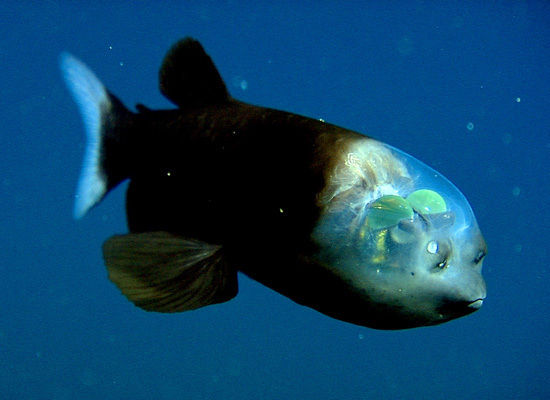
The Strange: Barreleye fish-the glass fish


As I browsed through random events on my Yahoo! front page...one of the titles caught my eye...mostly by its strange picture which appeared to have a fish with a lit-up head!

Alas, though the fish did not actually have a lit-up head, the Barreleye fish does have tubular eyes and a transparent head that does an excellent job of collecting light-->which is why it looks as though the head lights up!

When the fish was first described in 1939, people were in disbelief. Its eyes are surrounded by a transparent, fluid-filled shield that covers the top of the fish's head. This allows the fish to have some movement of the eye to look around the virtually black ocean around them for food.

In addition, the barreleye fish's big, flat fins allow for it to stay motionless and await for prey. Their small mouths suggest they are very selective in what they eat, but large digestive system suggests they can eat a variety of things...such as jellies!

Because these fishes live so deep in the ocean (down to where almost no sunlight can penetrate) it is very hard for oceanographers to find out about them, so research will continue to track the Barreleye fish and their survival patterns. To find out more about these weird looking fishes, click here.

Tuesday, April 14, 2009

Take Action: low cost spay and neuter


Ever think you see too many animals on the streets in your town its ridiculous? Well now's your chance to do something about it!

Low cost spay and neuter programs are supported all over the United States by various groups and organizations. In the Sacramento area, UC Davis Veterinary Medical Teaching Hospital provides the service monthly for low-income families. Programs such as these help keep the number of homeless animals to a minimum, and helps decrease the number of animals euthanized each year (up to millions!) because they cannot find permanent homes.

Neutering your male pets has been reported to help tame their behavior if you've got a wild one with non-stop energy! The animals will have a much lower testosterone levels which result in a calmer, more relaxed dog.

The money you pay (if any) usually goes towards a good cause such as your local SPCA or humane society or organizations supporting animal welfare and raising public awareness. So if you are adopting a pet or looking for a pet, please consider spaying/neutering your animal to prevent unwanted pregnancies and mating. And if you happen to have a few extra dollars in the pocket and are willing to help out your community, consider offering to pay for spay and neuters for the homeless animals in your neighborhood. For more information on finding low cost or free spay and neuters in YOUR neighborhood, click here.